
👣 The Lowdown on Corns: Understanding, Treatment, and Podiatry Expertise

Updated: Feb 5
Corns are one of the most common and often painful foot complaints, yet they are frequently misunderstood or improperly managed at home. Far from a minor annoyance, a corn is a sign that your foot is experiencing excessive, localised pressure and friction. Understanding what a corn is, why it forms, and how a podiatrist can help is crucial for long-term relief and foot health.

🔬 What Exactly is a Corn? A Podiatry Perspective
In simple terms, a corn (medically known as Heloma) is a small, concentrated area of thickened, dead skin—a thick, dense patch of hyperkeratosis. (Not to be confused with a verruca, which is a benign overgrowth of skin caused by a viral infection.) It develops as a protective response by the body's skin to repeated mechanical stress. Unlike a callus, which is a broader, flatter area of thick skin, a corn is typically small, round, and has a dense, central core, or nucleus.
It is this conical, hard nucleus that is the source of the intense, sharp pain. As pressure is applied (for example, when wearing a tight shoe, or walking), this hardened core presses inward like a stone in your shoe, irritating the underlying nerve endings and soft tissue.
Podiatrists classify corns based on their presentation and location:
Hard Corns (Heloma Durum): The most common type, usually found on the top or side of a toe, or on the sole of the foot, often over a bony prominence. They are dry and dense.
Soft Corns (Heloma Molle): These develop between the toes, most commonly between the fourth and fifth toe. They are kept moist by sweat, which sometimes gives them a whitish, rubbery texture.
🤔 Causes: Where Does the Pressure Come From?

The root cause of almost all corns is a consistent excessive force applied to a specific area of the skin, most commonly on the foot.
Ill-fitting Footwear: This is the most common culprit for corns on the toes. Shoes that are too tight, narrow, or shallow squeeze the toes and rub against bony areas. High-heeled shoes can also exacerbate the problem by forcing the foot forward and increasing pressure on the toes and the ball of the foot.
Foot Deformities: Conditions like hammer toes, bunions (Hallux Valgus), or claw toes, are structural changes that cause an area to be more prominent, and to push against the inside of a shoe.
Biomechanical Issues: An abnormal walking pattern, or gait, can lead to disproportionate pressure on certain parts of the foot. A podiatrist can assess this via biomechanical assessment.
Activity levels: If you play a lot of sports, or are on your feet a lot at work, this can make you more prone to corns.
Poor skin integrity: the effects of ageing and some health conditions can leave your skin less able to cope with the demands of being on your feet. It’s really important to manage any pressure points to prevent ulceration and bacterial infection.
🩹 Treatment and Management Strategies
While over-the-counter medicated corn plasters containing salicylic acid can soften the tough skin, they often pose risks, especially for those with diabetes or poor circulation, as they can damage healthy skin and lead to infection or ulceration. DIY corn removal using sharp implements, risks causing injury and scarring. Podiatric expertise is the safest and most effective solution.
Podiatric Treatment
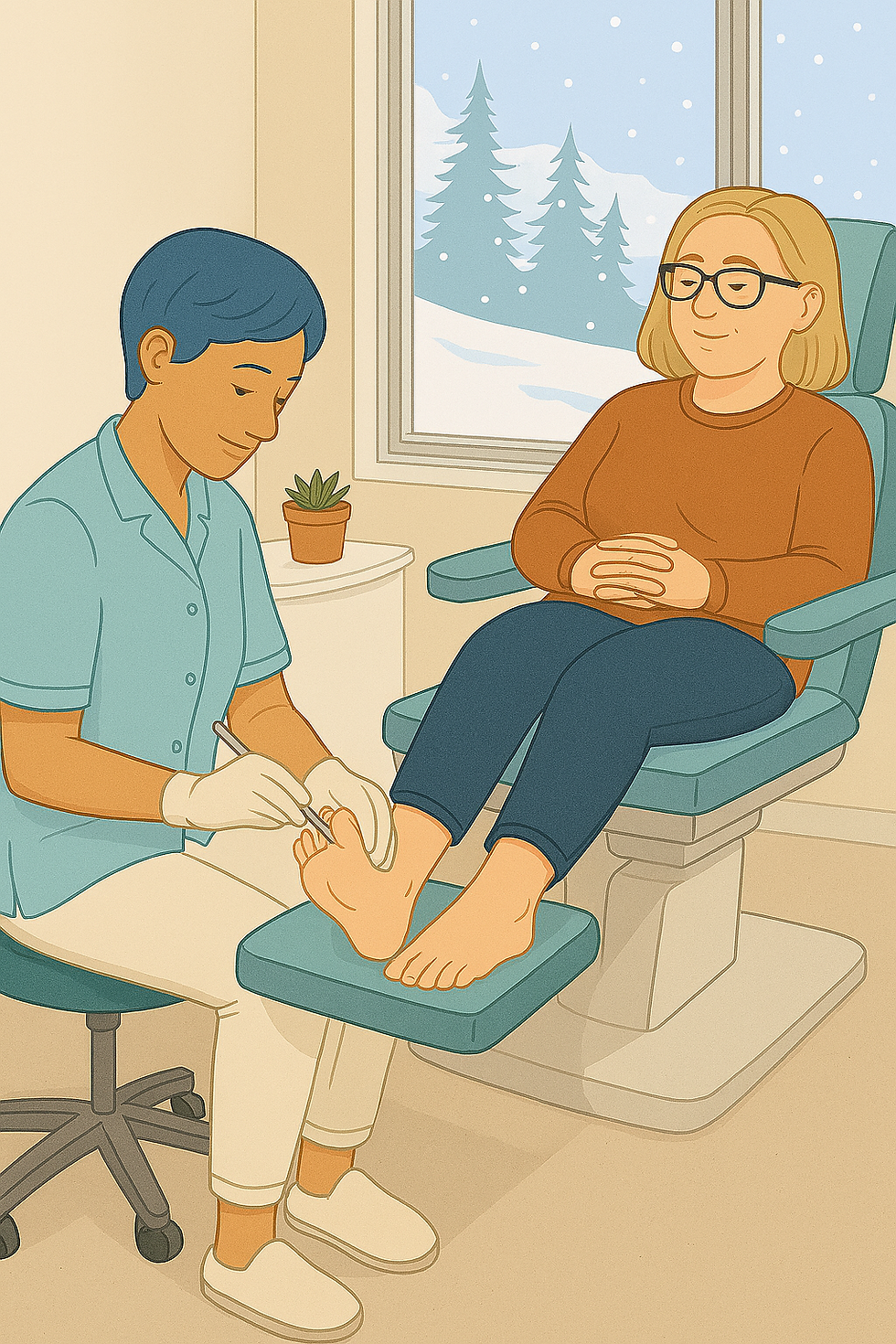
A podiatrist can provide immediate pain relief through a process called enucleation. Using a sterile scalpel, they skillfully and painlessly shave away the layers of thickened, dead skin, carefully removing the painful central core. Since the skin removed is dead, this procedure is generally comfortable. Podiatrists at Five Little Piggies have a variety of skills in their armoury to ensure optimum comfort, and always check in with you during treatments to make sure you are comfortable.
Long-Term Management
Simple removal is often temporary unless the underlying cause is addressed. A podiatrist's role is to identify this cause and implement a preventative management plan, which may include:
Footwear Advice: Guiding you toward shoes with a wider toe box, soft uppers, and adequate support to eliminate points of pressure.
Padding and Appliances: Using felt, foam, or silicone pads and wedges to redistribute pressure away from the affected area.
Custom Orthotics: For corns caused by poor biomechanics, custom-made or adapted off-the-shelf insoles can correct foot alignment and offload high-pressure zones, providing long-term relief.
Surgery: In rare, severe cases where a bony prominence is the unresolvable cause, minor corrective surgery may be recommended.
If you have a painful corn, or if you have an underlying health condition that affects your feet, such as diabetes, always seek professional care from a podiatrist to ensure safe and effective treatment. At Five Little Piggies, our staff are experts at dealing with corns and their associated problems - for more information, advice, or to book your consultation, fill out our contact form here.
Alternatively, call us on 0141 613 1113.


Comments